 |
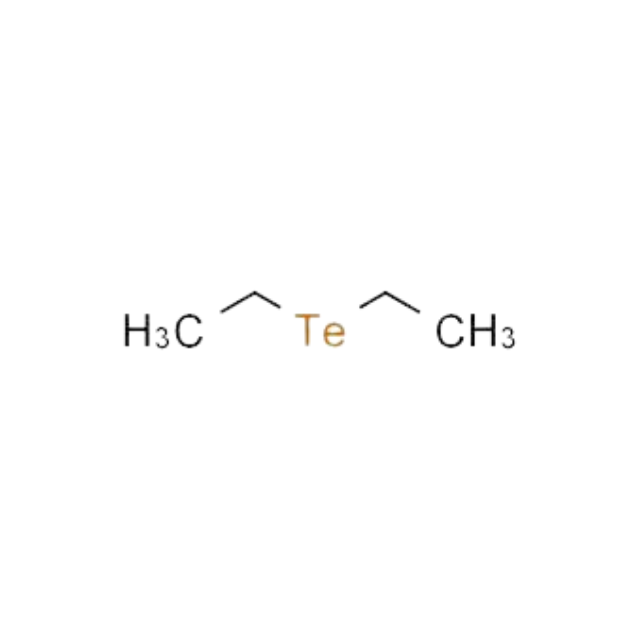


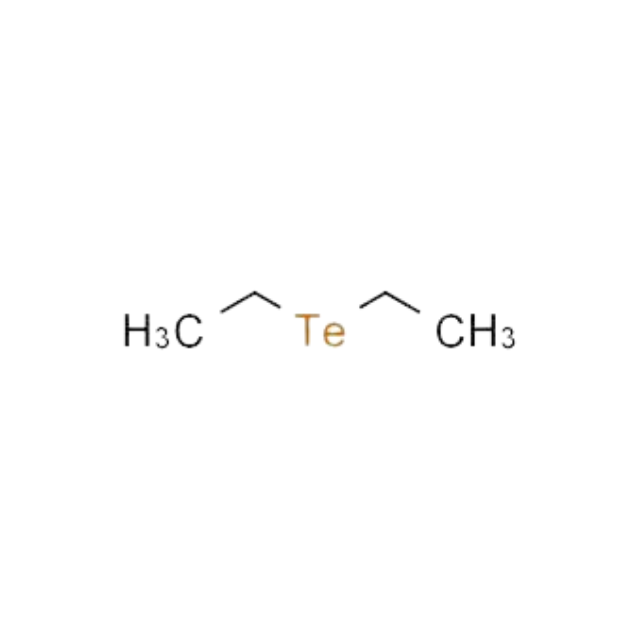
| Synonyms | 1,1’-tellurobis-ethan;1,1’-tellurobisethane; diethyltelluride; Diethyltellurium; Ethyltelluride |
| Molecular Formula | C4H10Te |
| Appearance | A pale yellow liquid with a strong, garlic-like odor |
| Molecular Weight | 185.72 |
| Boiling Point | 137-138 °C(lit.) |
| Density | 1.5990 |
| Refractive Index | 1.5182 |
| Flash Point | 42 ℃ |
| Storage Conditions | Room Temperature, Tightly Closed, Protect from Light, Well-Ventilated, Dry Place. |
| Solubility | Almost insoluble in water; soluble in ethanol. |
| Purity | 99%,Te-99.9999% |
| Package Information | 100g, 500g, 1kg, or customized |
Tellurium diethyl exhibits relatively high volatility compared with many inorganic tellurium compounds, making it suitable for vapor-phase processing and precursor-related research applications.
As an organotellurium compound, Tellurium diethyl can participate in various tellurium-containing organic synthesis reactions and advanced material preparation processes.
Its molecular structure makes it of interest in semiconductor thin-film deposition studies, particularly in research involving tellurium-containing materials.
High-purity grades of Tellurium diethyl may be used in electronic material research environments where impurity control is critical.
Tellurium-based materials are of interest in the development of optoelectronic and infrared-related semiconductor systems, where precise elemental incorporation and material purity are important. In research environments, Tellurium diethyl may be investigated as a precursor or intermediate for preparing tellurium-containing compounds and advanced semiconductor materials.
Tellurium diethyl has attracted attention in vapor deposition-related research because of its relatively volatile organotellurium structure. It may be investigated as a potential precursor material in Metal Organic Chemical Vapor Deposition (MOCVD) and Chemical Vapor Deposition (CVD) processes involving tellurium-containing thin films.
As a representative organotellurium compound, Tellurium diethyl is also used in organotellurium chemistry research and synthetic applications. Its organometallic characteristics make Tellurium diethyl useful for laboratory-scale studies involving reaction mechanisms, precursor modification, and the preparation of advanced tellurium-containing compounds.
Tellurium diethyl may also be explored in advanced thin-film material research, particularly in studies related to electronic materials, optoelectronic devices, and functional coatings. Thin-film deposition technologies often require precursor materials with suitable volatility and controlled decomposition properties, making organotellurium compounds relevant for exploratory material development.
Tellurium diethyl is sensitive to air and moisture and should be handled under inert gas conditions whenever possible.
Keep away from strong oxidizing agents, acids, and ignition sources.
Operations involving Tellurium diethyl should be conducted in a well-ventilated fume hood with appropriate PPE.
In case of skin contact, immediately wash the affected area with plenty of water and seek medical advice if irritation persists.
Store in tightly sealed containers under inert atmosphere in a cool and dry environment.
Transportation should comply with applicable hazardous chemical regulations.
1. What is the molecular formula of Tellurium Diethyl?
The molecular formula of Tellurium diethyl is C4H10Te. It is also commonly referred to as diethyltelluride, an organotellurium compound containing two ethyl groups bonded to a tellurium atom.
2. Is Tellurium Diethyl used in semiconductor applications?
Tellurium diethyl may be studied in semiconductor-related research, especially in areas involving tellurium-containing compound materials and thin-film deposition technologies. It has potential relevance in optoelectronic material research and vapor-phase deposition studies.
3. Is Tellurium Diethyl air sensitive?
Yes. Tellurium diethyl is generally considered sensitive to air and moisture. Prolonged exposure to oxygen or humid environments may affect its stability and chemical properties. For this reason, it is typically handled under inert atmosphere conditions such as nitrogen or argon protection.
4. How should Tellurium Diethyl be stored?
Tellurium diethyl should be stored in tightly sealed containers under inert gas conditions in a cool, dry, and well-ventilated environment. It should be protected from moisture, air exposure, heat sources, and strong oxidizing agents. Refrigerated storage may be recommended depending on purity grade and storage duration requirements.
Wolfa professionally supplies this product, supporting small-batch sampling and large-volume procurement needs. Packaging options include ordinary glass bottles, glass ampoules, metal ampoules, etc.
For product analysis reports (such as COA) or procurement consulting, please feel free to contact us at jomin@wolfachem.com at any time.


![Tris(N-Methylethanaminato)[(2-Methyl-2-Propanyl)Imino]Niobium,CAS 864150-47-0](http://ilrorwxhlpppln5m.ldycdn.com/cloud/lqBpiKpnliSRlllknklmkq/864150-640-640.png "CAS 864150-47-0,TBTEMN")