
Views: 48 Author: Site Editor Publish Time: 2026-04-15 Origin: Site



As semiconductor technology has advanced to the 10 nm process node, copper interconnect technology has become insufficient to meet the scaling requirements of advanced integrated circuits. Owing to its excellent electrical conductivity and stronger electromigration resistance, cobalt has emerged as a highly promising alternative, with particularly significant advantages in high-frequency devices and ultra-scaled chips.
When filling high aspect ratio vias (e.g., 40:1), cobalt effectively avoids the “void defect” issues commonly observed in copper electroplating. In addition, cobalt films can directly serve as diffusion barrier layers and adhesion layers for copper interconnects, which not only reduces the thickness of traditional Ta/TaN layers but also increases the volume of copper lines, thereby lowering resistance.
Taking TSMC’s 7 nm process as an example, the application of cobalt involves etching contact holes with diameters smaller than 20 nm in the source/drain regions, followed by filling cobalt via ALD to form an approximately 5 nm-thick CoSi₂ contact layer. Subsequently, copper or cobalt interconnect lines are deposited on this contact layer, where cobalt also functions as a diffusion barrier for copper.
At present, Applied Materials has developed dedicated equipment for cobalt deposition, which has already been deployed in mass production, mainly for logic chip manufacturing.
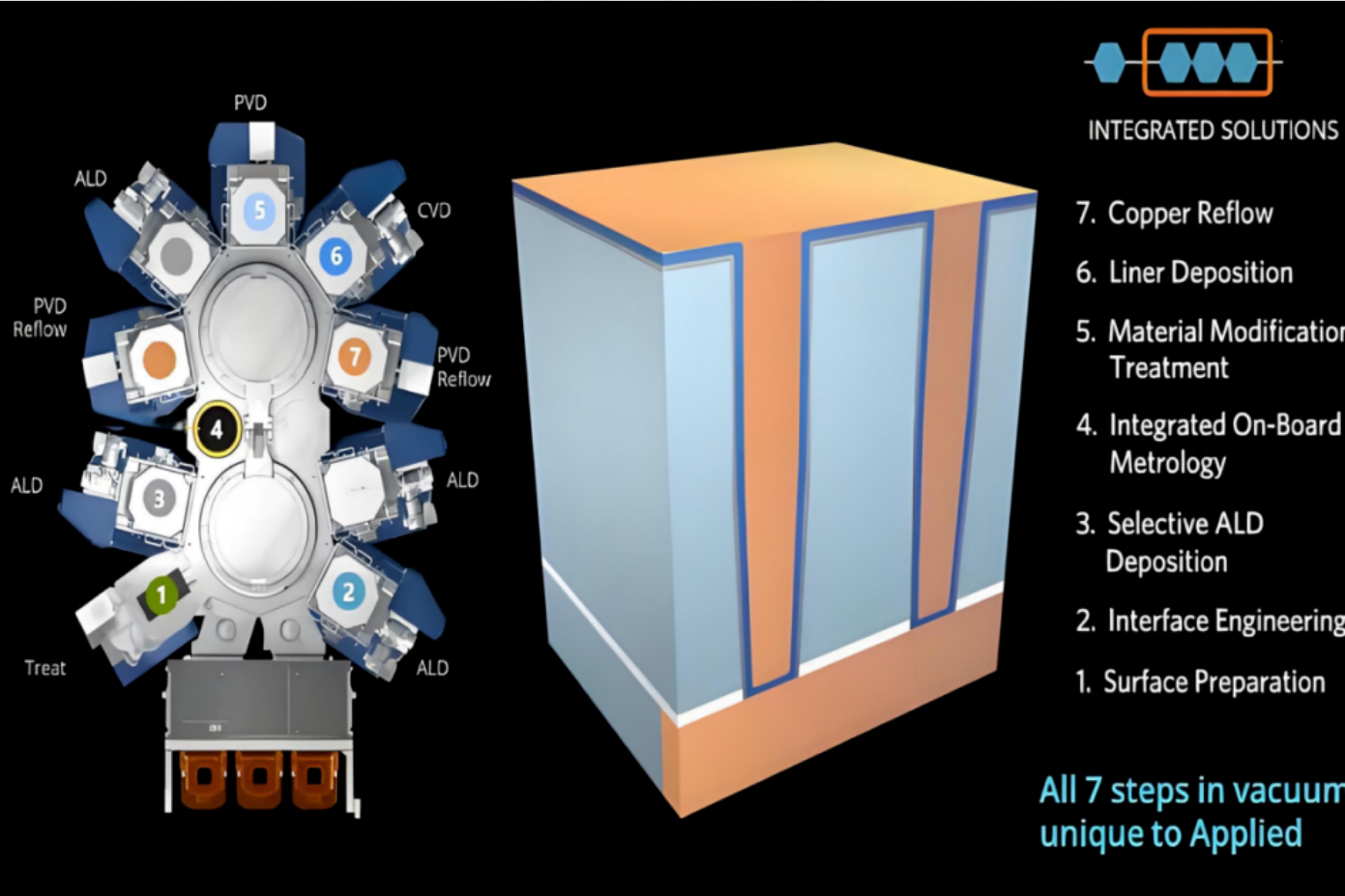
Electromigration is a failure mode of metal materials in semiconductors. When current passes through a metal line, metal atoms migrate under the influence of an electric field, leading to damage of the line.
Cobalt exhibits relatively strong resistance to electromigration; therefore, under high power and high current density conditions, it can maintain a longer service life and reduce chip failure.
In certain steps of the metallization process, cobalt-based alloys are used as seed layer materials to promote subsequent metal deposition, which helps improve the quality and uniformity of the metal layers.
Cobalt precursors can be classified into solid and liquid types, with significant differences in thermal stability, volatility, and reactivity.
Precursor Type | Thermal Stability | Volatility | Temperature Conditions | Main Products |
Solid Precursors | Higher | Lower | High Temperature | CoCp₂, Co(MeCp)₂ |
Liquid Precursors | Lower | Higher | Low Temperature | CCTBA, CpCo(CO)₂ |
CoCp₂ is one of the earliest and most widely studied cobalt precursors. Due to its simple molecular structure, it exhibits good self-limiting reaction characteristics in ALD processes. However, CoCp₂ has relatively high thermal stability and typically requires temperatures above 250°C to achieve stable film growth.
For example, reference [1] reports the preparation of cobalt thin films using CoCp₂ and NH₃ plasma via plasma-enhanced ALD (PE-ALD). The experimental results show that CoCp₂ achieves the optimal growth rate (0.048 nm/cycle) at 300°C, with a relatively low film resistivity (10 μΩ·cm). However, its high temperature requirement limits its potential in low-temperature applications.
Co(MeCp)₂ is a derivative of CoCp₂, where methyl groups are introduced onto the cyclopentadienyl rings to reduce the thermal decomposition temperature of the precursor.
Reference [2] reports the preparation of cobalt thin films using Co(MeCp)₂ and NH₃ plasma via PE-ALD. The results show that Co(MeCp)₂ exhibits a stable ALD window in the temperature range of 200°C to 350°C, with a growth rate of 0.04–0.06 nm/cycle and a film resistivity of 31 μΩ·cm.
Compared with CoCp₂, Co(MeCp)₂ shows better reactivity at lower temperatures, making it more suitable for low-temperature ALD processes.
TMSCpCo(CO)₂ is a cobalt precursor based on a cyclopentadienyl (Cp) ligand. Reference [3] reports the preparation of cobalt thin films using TMSCpCo(CO)₂ and tert-butylamine (tBuNH₂) via thermal ALD.
The results show that TMSCpCo(CO)₂ exhibits a stable ALD window in the temperature range of 275°C to 325°C, with growth rates of 0.045 nm/cycle (R = H) and 0.03 nm/cycle (R = TMS).
CpCo(CO)₂ is a liquid cobalt precursor with high volatility and a low thermal decomposition temperature. Reference [4] reports the preparation of cobalt oxide thin films using CpCo(CO)₂ and O₃ via ALD.
The results show that CpCo(CO)₂ exhibits a stable ALD window in the temperature range of 50°C to 150°C, with a growth rate of 0.08–0.11 nm/cycle.
CCTBA [(3,3-dimethyl-1-butyne) dicobalt hexacarbonyl] is a liquid cobalt precursor with high volatility and a low thermal decomposition temperature. Reference [5] reports the preparation of cobalt thin films using CCTBA and H₂ via thermal ALD.
The results show that CCTBA exhibits self-limiting reaction behavior at 100°C, with a growth rate of 0.051 nm/cycle.
3.1 Low-temperature deposition: Compared with solid Co sources, liquid Co sources exhibit self-limiting reaction characteristics, making them suitable for low-temperature ALD deposition and reducing thermal budget.
3.2 Excellent film uniformity and step coverage: When combined with ALD technology, liquid Co sources enable nanometer-scale precision in film thickness control, ensuring film uniformity and consistency. They also allow uniform film deposition on high aspect ratio structures, ensuring integrity and reliability in complex geometries.
3.3 Excellent electrochemical performance:
Low resistivity: cobalt films deposited from liquid Co sources exhibit resistivity as low as 10.6 μΩ·cm, approaching that of bulk cobalt (6.24 μΩ·cm);
Good crystallinity: thermal annealing significantly improves the crystallinity of cobalt films;
Good chemical stability: cobalt oxide films exhibit good chemical stability under reaction conditions, making them suitable for high-performance microelectronic devices.
The application of cobalt precursors in ALD provides an important pathway for the preparation of high-quality cobalt thin films. By selecting suitable precursors and optimizing ALD process parameters, high-quality cobalt films can be produced for various application scenarios.
In the future, with the development of new liquid precursors and further optimization of ALD processes, the application prospects of cobalt films in microelectronics and magnetic storage devices will become even broader.
We can stably supply precursors such as dicobalt octacarbonyl, cyclopentadienyl cobalt dicarbonyl, and (3,3-dimethyl-1-butyne) dicobalt hexacarbonyl. Customized products are also available. If you have any related product requirements, please feel free to contact us!
No. | English Name | CAS Number | Chemical Formula |
1 | Cobalt carbonyl | 10210-68-1 | Co2(CO)8 |
2 | Dicarbonylcyclopen-tadienyl cobalt | 12078-25-0 | CpCo(CO)2 |
3 | (3,3-dimethyl-1-butyne) dicobalt hexacarbonyl | 56792-69-9 | CCTBA |
4 | Tungsten hexacarbonyl | 14040-11-0 | W(CO)6 |
5 | Molybdenum hexacarbonyl | 13939-06-5 | Mo(CO)6 |
6 | Chromium hexacarbonyl | 13007-92-6 | Cr(CO)6 |
7 | Ruthenium chloride hydrate | 14898-67-0 | RuCl3·xH2O |
8 | Triruthenium dodecacarbonyl | 15243-33-1 | Ru3(CO)12 |
9 | Bis(ethylcyclopentadienyl) ruthenium | 32992-96-4 | Ru(EtCp)2 |
10 | Tetrakis(dimethylamino) hafnium | 19782-68-4 | TDMAH |
11 | Tetrakis(dimethylamino) zirconium | 19756-04-8 | TDMAZ |
12 | Tetrakis (dimethylamino) titanium | 3275-24-9 | TDMAT |
13 | Tetrakis (dimethylamino) tin | 1066-77-9 | TDMASn |
[1] Lee, H. B., et al. Electrochem. Solid-State Lett. 9 (2006): G323-G325. DOI: 10.1149/1.2338777
[2] Park, J., et al. J. Energy Chem. 22 (2013): 403-407. DOI: 10.1016/j.surfcoat.2014.05.005
[3] Xuan Zhong, et al. Materials Letters. (2022): 311. DOI: 10.1016/j.matlet.2021.131605
[4] Han, B., et al. J. Vac. Sci. Technol. A 31 (2013): 01A145. DOI: http://dx.doi.org/10.1116/1.4772461
[5] Yamaguchi, J., et al. ECS J. Solid State Sci. Technol. 12 (2023): 114003. DOI: 10.1149/2162-8777/ad07ee


